
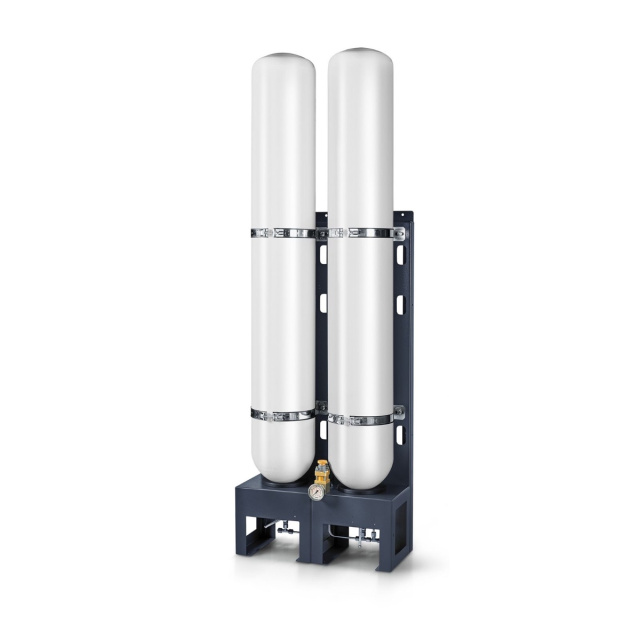
High-pressure storage systems
Modular cylinder storage system for pressures up to 420 bar
- Up to 420 bar
- Modular expandable storage volume, e.g. 50 l or 80 l per cylinder
- Wall-mounted or free-standing version available
Request product
- SKU
- HD-Speicher-IND
In stock
Technical Data
High-pressure storage systems – for air and gases
| Storage system | Operating pressure | Geometric volume | Number of cylinders | |
|---|---|---|---|---|
| 330 bar | 420 bar | Liter | ||
| B 50 | – | ✓ | 50 | 1 |
| B 80 | ✓ | – | 80 | 1 |
-
Details & Features
The modular storage system is the ideal addition to compressor systems and ensures a stable pressure supply for air and gas applications. Available in pressure stages of 330 bar and 420 bar, it reduces pressure fluctuations during peak demand and reduces the frequency of compressor start-ups. Flexible expansion with 50- or 80-litre storage cylinders allows the system to be tailored precisely to requirements and supports smooth, efficient system operation.
Storage cylinder with console
A module consists of a storage cylinder that is pre-piped and ready for connection, mounted on a console for floor or wall installation. Based on 50 l or 80 l storage cylinders, these storage systems can be expanded as required.
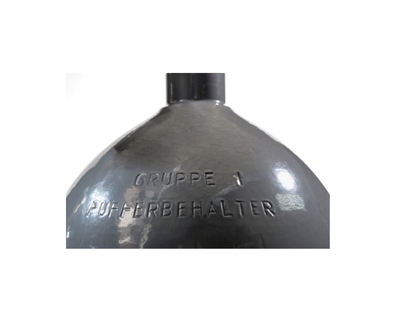
Pressure vessel
The storage cylinders comply with DGRL2014/68/EU (PED) and are intended for stationary applications.
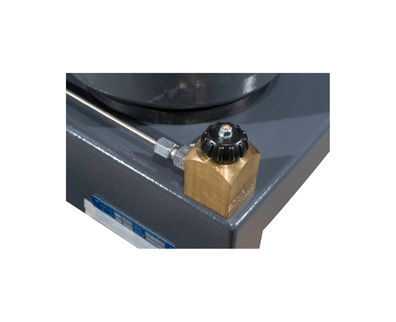
Condensate drain
Depending on the application or due to insufficient air or gas treatment, condensate can accumulate in high-pressure storage systems. All standard storage vessels from BAUER KOMPRESSOREN are therefore equipped with a manual condensate drain.
Options
Safety valve and pressure gauge
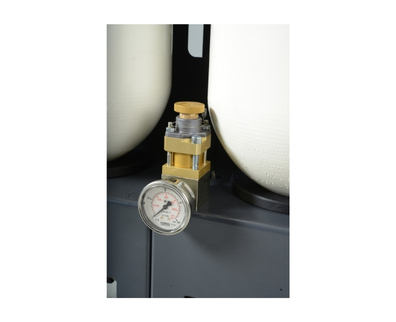
Safety valve and pressure gauge are mounted on the console of the first module. This is mandatory if exceeding the maximum permissible storage pressure cannot be otherwise avoided, e.g. by approved safety valves on the compressor or in the pipeline.
The storage design
Storage system design – the basis for efficient compressor operation
A correctly dimensioned storage system is one of the key components of a high-pressure setup. It reduces pressure fluctuations during intermittent air withdrawal and decreases compressor start frequency by providing sufficient storage capacity. The pressure vessels and final separators in high-pressure compressors are designed for a limited number of load cycles. Fewer start-stop cycles significantly extend the service life of these components.
To ensure optimal operation, the compressor should ideally run no more than two to four cycles per hour. BAUER industrial compressors are equipped with cycle counters as standard, which record actual start cycles and support safe, efficient system control.
The size of the storage system depends on:
- Compressor delivery rate (l/min)
- Air consumption of the specific application
- Pressure differential between start and stop (hysteresis)
Simplified formula for sizing a high-pressure storage system (based on 4 load cycles/hour):

- Vk (l/min): Compressor delivery volume in liters per minute
- V (l): Storage volume in liters (water volume)
- Δp (bar): Pressure differential (hysteresis) in bar
We recommend a pressure differential Δp of max. 60 bar for continuous operation. Within this range, stationary high-pressure storage cylinders are typically rated for continuous duty. For higher differentials, the number of allowable filling cycles is limited. Please refer to the documentation for the specific pressure vessel.
-
Downloads
-
