AIR- POWERING COMPETITION
On 31 August and 1 September, Potsdamer Platz became a stunning stage set for this year’s finale of the Firefighter Combat Challenge, or FCC. The competitors had already met two weeks previously for a trial of strength at the FCC heats in the Franconian town of Geiselwind.
Originating from the USA, the competition is based on disciplines from the daily routine of firefighters and is now a well-established event in Germany. How reputable the FCC Germany is, was clear from the list from Germany, the UK, France, Switzerland, Poland, Canada, Norway, the Czech Republic and many other countries besides – totalling over 500 competitors.
The scaffolding of the competition tower rose into the Berlin sunrise, silhouetted against the high-tech glass buildings that lined the square. The very first challenge in the competition required entrants to run up 60 steps with a height of 12.5 metres – no easy task in full breathing gear while carrying a 19-kg fire hose over one shoulder!
Under these conditions, it’s all the more important that the quality of breathing air is beyond all doubt. As in previous competitions, BAUER was responsible for the entire supply of breathing air. The filling area behind the starting line contained a VERTICUS SUPER SILENT model, which was working at full blast to produce the enormous volumes of breathing air required. Two storage cylinders provided a safety reserve to prevent any supply bottleneck; the four filling panel connectors were virtually unceasingly hooked up to 300-bar composite cylinders.
The starter’s signal for the first competition sounded, and the first two finalists hurtled up the steps at breakneck speed under the watchful eyes of the judges. The staccato clang of the firefighters’ boots on the metal steps mixed with raucous shouts of encouragement from the supporting teams. At the top of the tower was a rope from which a further bundle of hose was suspended; the aim was to pull the rope up as fast as possible.
Then the competitors immediately headed back down to a Keiser Force Machine – a kind of fairground “test-your-strength” on steroids – where they had to wield an enormous sledgehammer to propel a 72.5-kg metal anvil along a set of rails. There followed a sprint along a slalom route around five pylons, at the end of which a fire hose lay ready. The hose had to be dragged over twenty metres and then pulled through a swing door; the water jet had to hit a target only 20 centimetres wide from a distance of four metres.
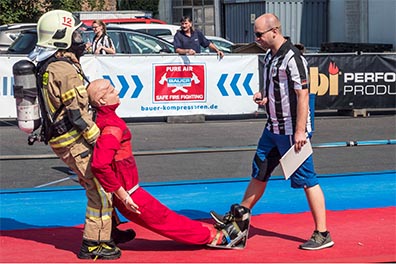
Once that was completed, the final challenge lay ahead: an 80-kilometre dummy had to be carried backwards over a 30-metre route. The strain was only too visible on the faces of the competitors; by the final few metres, most of them had clearly used up their physical reserves. The seconds ticked implacably away, tracked by the digital display over the finishing line. The competitors threw themselves over the last few metres to the finishing line, ripped off their steamed-up masks and gulped down air after their exertions, their thigh muscles burning and their scarlet faces dripping with sweat.
The winner, Phillip Kaiser from the Lions Den Team, completed the course in an amazing 1:32 minutes to scoop the title. The majority of the field took over two minutes to finish. But on the second day, the winning team, also Lions Den, actually improved on this record, completing the circuit in only 1:17 seconds – admittedly, dividing tasks up among up to five team members.
By 5 pm the competition was over, and all the teams had showed off their skills. In the evening, the prizes were awarded and the winners were feted in well-earned celebrations.